
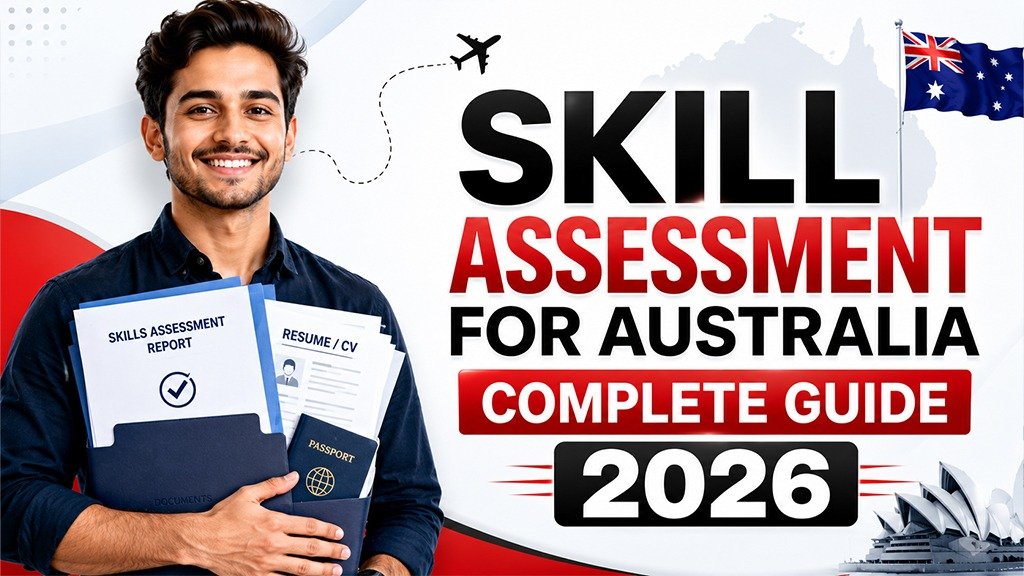
What is Skill Assessment for Australian Migration?
A Skill Assessment is an official evaluation of your education, work experience and professional skills done by an approved Australian authority to confirm that you meet Australian standards for your occupation.
It is a mandatory requirement for most skilled visas like:
- Subclass 189 (Skilled Independent)
- Subclass 190 (Skilled Nominated)
- Subclass 491 (Skilled Work Regional)
- Subclass 186 (Employer Sponsored PR)
👉 Official reference: Australian Government Skills Assessment
Why Skill Assessment is Important?
A positive skill assessment is the first critical step in your Australia PR journey.
Key Reasons
- Confirms your occupation matches Australian standards
- Required before lodging EOI (Expression of Interest)
- Helps claim points for work experience and qualification
- Mandatory for visa invitation eligibility
Without Skill Assessment
- You cannot apply for 189 / 190 / 491 visas
- Your EOI will not be valid
- You cannot proceed to invitation stage
Who Conducts Skill Assessment?
Australia has different assessing authorities depending on your occupation.
Major Assessing Bodies
TRA (Trades Recognition Australia)
For trade occupations like:
- Chef
- Electrician
- Plumber
- Carpenter
👉 TRA Official Website
ACS (Australian Computer Society)
For IT occupations like:
- Software Engineer
- Developer
- Data Analyst
👉 ACS Official Website
Engineers Australia (EA)
For engineering occupations:
- Civil Engineer
- Mechanical Engineer
- Electrical Engineer
👉 Engineers Australia
VETASSESS
For general professional occupations:
- Marketing
- HR
- Management roles
Skill Assessment Process (Step-by-Step)
Step 1 – Choose Correct Occupation (ANZSCO Code)
Your occupation must match your:
- Job role
- Education
- Experience
Step 2 – Select Assessing Authority
Example:
- Chef → TRA
- IT → ACS
- Engineer → EA
Step 3 – Submit Documents
Common documents include:
- Passport
- Degree certificates
- Work experience letters
- Salary proof
Step 4 – Authority Review
The authority checks:
- Qualification relevance
- Work experience relevance
- Job duties match
Step 5 – Result Outcome
You will receive:
- Positive Skill Assessment OR
- Negative Assessment OR
- Request for more documents
Skill Assessment Required for Which Visas?
Skilled Migration Visas
- Subclass 189 – Independent PR
- Subclass 190 – State nominated PR
- Subclass 491 – Regional visa
Employer Sponsored Visas
- Subclass 186 – Permanent Residency
- Subclass 482 – Temporary Skill Shortage Visa
Types of Skill Assessment Authorities
Trade Occupations
Handled by TRA
IT Occupations
Handled by ACS
Engineering Occupations
Handled by Engineers Australia
Business & General Roles
Handled by VETASSESS
Common Mistakes in Skill Assessment
Wrong ANZSCO Selection
Choosing incorrect occupation code reduces approval chances.
Weak Experience Letters
Must include:
- Job duties
- Working hours
- Tools/skills used
Insufficient Evidence
Missing payslips or tax documents can lead to rejection.
Processing Time & Validity
Processing Time
- TRA: 4–12 weeks
- ACS: 4–8 weeks
- EA: 6–12 weeks
- VETASSESS: 8–12 weeks
Validity
Most assessments are valid for:
- 2 to 3 years (varies by authority)
Benefits of Positive Skill Assessment
PR Eligibility
- Required for Subclass 189, 190, 491
Points Advantage
- Helps claim migration points
Career Opportunities
- Recognised skills in Australia
- Better job prospects
How Baasu Consultants Can Help
At Baasu Consultants, we provide complete support for skill assessment and migration:
Our Services
- Correct ANZSCO selection
- Documentation preparation
- TRA / ACS / EA guidance
- PR visa strategy planning
- EOI submission support
👉 Important Links:
- https://www.baasu.com/australia-pr-strategy-2026-189-vs-190-vs-491-vs-186/
- https://www.baasu.com/migration-consultants-chennai/permanent-migration-for-australia/
Final Summary
A Skill Assessment is the foundation of Australian skilled migration. Without it, you cannot proceed to pathways like Subclass 189, 190 or 491.
Choosing the right authority (TRA, ACS, Engineers Australia or VETASSESS) and submitting strong documentation is critical for success.